
‘Ted Lasso’ Season 4 Episode 4 Recap: Inside Every Team There Are Two Wolves
See more of our coverage in your search results.
There are two ways to approach this season of Ted Lasso on Apple TV.
The first is evaluating the traditional narrative pluses and minuses, and the emotional effects those engender in the viewer. I confess that I’ve neglected some of those up to now, mainly because there was so much onboarding with new characters and new challenges that the Scooby Gang fell by the wayside.
The other way is to examine the show’s relationship to women’s football. Some of Jason Sudeikis’s and co-showrunner Jack Burditt’s efforts to bring the audience inside the struggles of being a women’s footballer in England have paid off. Some of them haven’t. Yet one cannot dismiss the sincere effort on the writers’ parts.
Episode 4 offers a good opportunity to tackle both sides of the Ted Lasso coin, and why the show can enervate its objectives too often.
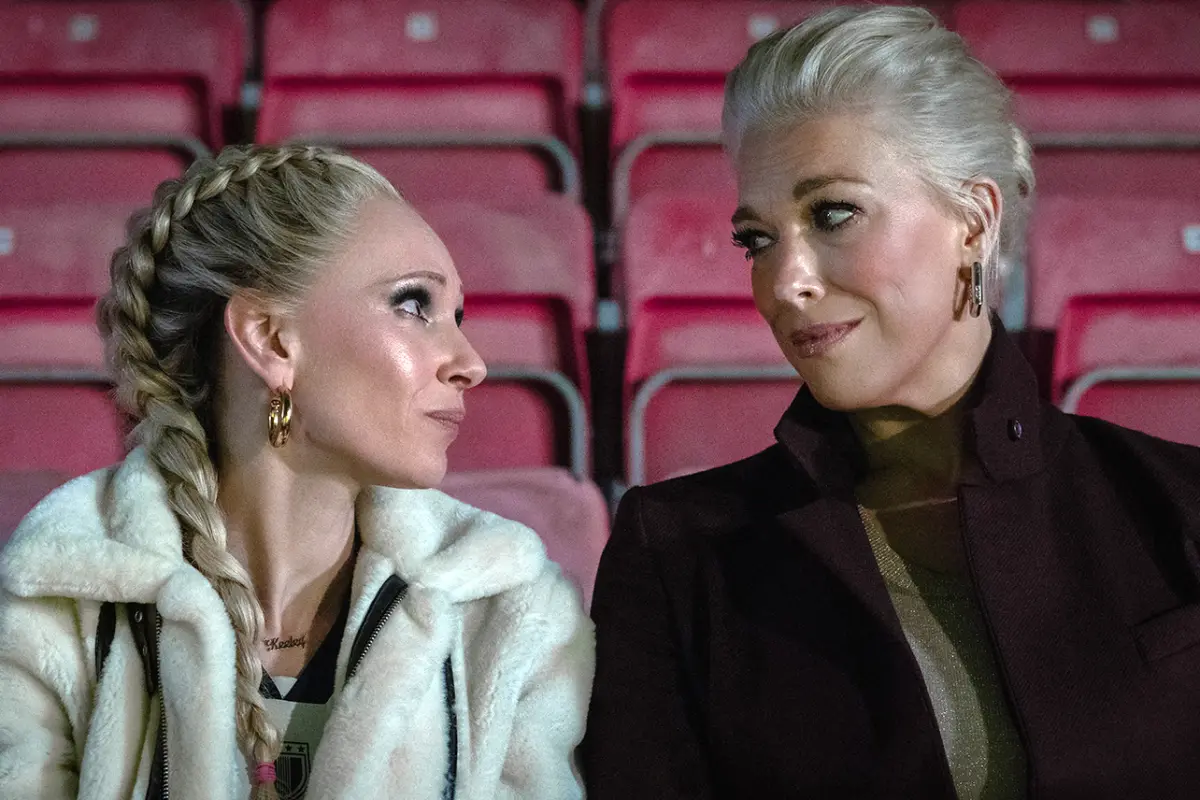
Let’s start with the episode’s B plot, which finds Rebecca and Keeley attending a conference on the business of women’s sports. Keeley is entranced and Rebecca is lightly repulsed by the event’s keynote speaker, one Zelda Southport (Tracey Ullman). Southport runs an investment fund that buys ownership stakes in women’s sports teams, and is recognized as an industry leader as a result.
The storyline was clearly inspired by one of the season’s consultants, Kara Nortman. Nortman is a managing partner at Monarch Collective, and was a co-founder of Angel City Football Club in Los Angeles. Nortman, along with co-founders Julie Uhrman and Natalie Portman (yes that one), decided that all you needed to build a financially viable women’s sports team was enough money and enough belief. They weren’t wrong, as Angel City is now valued at more than $300 million, a mere six years after the founders started the team for a $2 million expansion fee.
Ullman’s performance as Southport is a bit too punk rock to be an exact Nortman analogue, and I doubt Nortman has ever spit so much venom at an investor conference as Southport does to the room full of stuffy white men. Southport is an exaggerated version of a very real type of person from the last few years, who decided not to take “no” for an answer and make women’s sports a massive growth sector.
Keeley is instantly inspired by Southport’s freewheeling can-doism, while Rebecca remains cautious. The show is on Keeley’s side; after all, who wants to be aligned with the old men who only put their money in women’s sports for “the great press and occasional reputation laundering”? I’ve noted over the past two weeks that the biggest predictor for success in women’s soccer is money. If there are people like Southport ready to pour money into the sport, we should theoretically let them.
An ostensible civic trust like a professional sports team and financial instruments like venture capital and private equity quickly make for awkward bedfellows. Professional sports aren’t meant to be profitable, and rarely have been throughout their 150-year history in Europe and North America. Institutional investors only care about profitability, and once they decide that they can’t make a good return on their investment, they’ll pull out, and potentially leave the club and its players high and dry.
A recent example from other sports involves Mark Walter, owner of the Los Angeles Dodgers, recent owner of the Los Angeles Lakers, minority owner of Chelsea men’s and women’s teams, and total owner of the Professional Women’s Hockey League. Two weeks ago, Walter sold the Lakers less than a year after buying the team along with his stake in Chelsea, while a tax fraud investigation hangs over his head. A women’s hockey league is the loss leader in his sports portfolio, and if Walter decides to drastically reduce funding, 300 players could find their professional futures much less stable.
The whims of individuals whose motivations are profit and not to caretake institutions with deep community roots can make the skyrocketing growth of women’s football more precarious than it may appear on the outside. Even Nortman herself has run into conflict-of-interest issues with Monarch buying stakes in clubs that actually play against each other, as Angel City, the Boston Legacy, and the San Diego Wave have done this season in the National Women’s Soccer League. (See also Michele Kang’s ownership of London City Lionesses in England and OL Lyonnes in France, who may one day encounter each other in the UEFA Women’s Champions League.)
Is Rebecca right to be so cautious, then? No, she’s not. What she cannot demand, however, is for Richmond Ladies to be a serious short-term revenue generator while she continues to put money into the club. The money she spends now will help build the foundation necessary for long-term success, especially if Rebecca remains committed to the project. Spending money in the right way without worrying what profit margin they can hit in the next season is the secret sauce.
That leads us to the second part of the Ted Lasso equation: all of this is background for the development of Rebecca’s and Keeley’s relationship. Rebecca acts skittishly about getting involved with Southport, but Burditt and the writers don’t give those moments the space or the depth to land with any substance. Instead, the complex dynamics of the women’s sports economy are reduced to one friend acting nervous and saying, “No,” to the other friend, and the other friend saying, “Don’t worry, it always makes me better in the long run,” as Keeley remarks while they test out a pregame fireworks display. (Don’t get me started on why that’s often a terrible idea.)
It’s a classic Ted Lasso conflict. Two characters are at odds, but for vaguely described reasons, and it gets resolved almost as soon as it begins. Rebecca feels bad about saying “no” but it’s only because she doesn’t have Keeley’s adventurous spirit. Keeley wishes she got the green light more often, but it’s only because she’s so passionate about her work, and besides, hearing “no” just makes plan B that much stronger. Meanwhile, the audience never actually sees plan B, or why it would be better, or why Rebecca’s reticence might have substance beyond her inability to respect her friend’s professional growth for a hot second.
Keeley’s other source of conflict involves Roy. She slammed the door in Roy’s (and Jamie’s) face in the season 3 finale, after his macho demand that she choose one of them makes her choose neither. In the premiere, she tells Ted that she and Roy are really good friends, while the sexual tension is so obvious between them that you could cut it with a butter knife.
This week, Roy asks Keeley if he’s “allowed to ask,” revealing to Higgins that he wants to try again for a relationship. (Higgins would rather be anywhere else.) Keeley reveals that she has made Roy wait for nearly three years because he’s “not ready.” He hasn’t dated anyone else because he wants to be with Keeley. “Yeah, for now,” Keeley responds.
According to Keeley, Roy has had sex with people without actually getting to know them as people, all while putting Keeley “on this fucking pedestal.” By the end of this kerfuffle, Roy has gotten Keeley to agree that he can go on 10 dates, and then they can discuss.
I’m sorry, but what is this nonsense? First and foremost, Burditt and the writers are essentially re-running the tension between Roy and Keeley from Season 1, where Keeley wanted Roy to be more emotionally available in order for the two of them to date. They got through that, and their love blossomed for more than a season.
Secondly, if Roy has put Keeley on a pedestal, we haven’t seen it in either words or actions. He’s been respectful, supportive, kind, and most importantly, has treated Keeley like an actual human being, not an obscure object of desire. Roy seems to know his heart well, while Keeley is just trying to make up reasons for them to be apart.
This plan naturally backfires on Keeley. Roy goes on some comically short dates, several in the same night that begin to overlap. An attempt at sleeping with a bartender on her break aggravates his recurring knee problem, and he ends up in the office of Dr. Erin Beaumont (Laura Haddock) as a favor to Roy’s sister. Wouldn’t you know it, Beaumont isn’t interested in putting up with any of Roy’s bullshit. He demands her number.
If the show wishes for us to think that Keeley is reasonable in her request, then we have nothing to base her opinion on. If the show thinks that Keeley is getting in her own way, then we have nothing to base that assessment on, either. Roy and Keeley are wearing relationship plot armor: the obvious cannot occur for no other reason than “it has to happen later.” When will “later” finally come?!?
Evan Davis is a contributing writer to Decider. He hosts Expected Own Goals, a podcast about women’s soccer.
Source: Read original story